
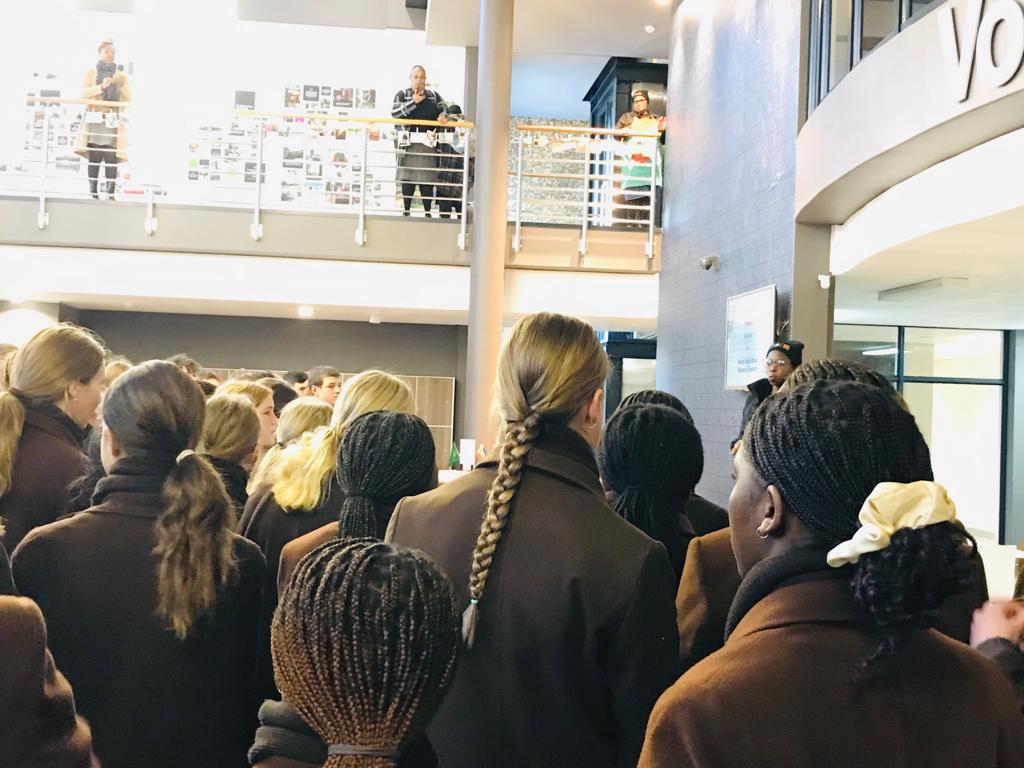
The learners were introduced to the types of exhibitions that the museum has including the permanent exhibition (Voices of the Land), the temporary (Cycles and the Children’s Literature Exhibitions), travelling exhibitions, as well as various digital exhibitions. Thereafter, the learners proceeded to the auditorium for a presentation on literary works.
The presentation commenced with a discussion on the different types of museums that exist including e.g. natural science and social science museums. This laid a foundation for the discussion of the kind of museum Amazwi is – a unique museum collecting, curating and exhibiting literary heritage. This was also expanded to include that the museum conceptualizes and conducts programmes in line with the latter heritage.
A brief history of Amazwi was offered. Amazwi started off as a documentation centre at Rhodes University (RU) by Professor Guy Butler. In 1980 it became the National English Literary Museum where it collected English writings by all races and grew from there. The museum has two satellites viz. The Eastern star (which exhibits the history of the printing press) as well as the Schreiner House in Cradock (which exhibits the legacy of Olive Schreiner). The museum recently underwent a name change to Amazwi South African Museum of Literature. The museum is an entity of the national Department of Sport, Arts and Culture.
The presentation then looked at local creatives within the literary writings including Harry Owen, J. Mckeown, D. Wylie, L. Solomons, Akhona ‘Bhodlingqaka’ Mafani, Anton Krueger, the late Steader Nkwinti, the late Siphelele Dyongman, Siphiwo Mahala and others. This was followed by a discussion of the publishing houses as well as publications within Makhanda including Aerial Publishing, Deep South, Ink Sword, RU MACW (Tyhini) to mention a few. RU Centre for Social Development (CSD) & Amazwi have also published 20 Big Makhanda BookDashX books. The presentation also looked at the courses offered in the field of literary works including the Master’s in Creative Writing (MACW), the Institute for the Study of the Englishes of Africa (ISEA) Creative Writing Short Course and other writing workshops. Amazwi also has its creatives that have shared their writings in various literary platforms.
The learners were also introduced to various creative platforms. These include the Reddits (an Open Mic platform hosted by Amazwi), National Arts Festival & Litfest (and defunct Wordfest / Thinkfest), MACW Readings, Amazwi Book Launches, Fingo Festivals & the Black Power Station, Cory Library (with theses and several African writings), Department of Literary Studies (formerly English Department), School of African Languages (including Afrikaans and Nederlands), Local Bathurst Book Fair (end of April) & SKWF (mid-June), other National and International Literary Festivals & Book Fairs, Amazwi-PUKU Children Storytelling Festival and the Setwork Festival.
The presentation also looked at awards and journals for literary works. It was discussed that the SALA (South African Literary Awards) is major. Rhodes University, through the MACW, has produced 3 SALA winners in IsiXhosa poetry: Mangaliso Buzani, Simphiwo Nolutshungu and Ayanda Billie. The New Coin is the most popular local literary journal and it has been in circulation for over 50 years. RU’s MACW also produces an annual journal called Tyhini in various languages for its students.
The discussion also delved into the various prescribed books and setworks. It was discussed that schools have literature setworks (mostly as a 3rd paper in terms of assessment for and of learning). These are in all languages studied at high schools i.e. from grades 8 to 12. Various genres are studied over a number of years per grade. These include but are not limited to poetry, novels, drama and short stories. Amazwi sometimes runs an annual Prescribed Literature Festival. It is also understood that each university prescribes its own material.
Various adaptations of literary works were also engaged upon. These include film, radio, television, stage plays, storytelling and puppetry. There was also a discussion of some of the important literary works including Buzani Kubawo – by W.K. Tamsanqa, Ingqumbo Yeminyanya (The Wrath of the Ancestors) – by A.C. Jordan, Ityala Lamawele (The Lawsuit of the Twins) – by S.E.K. Mqhayi, AbaKwazidenge (Hill of Fools) – R.L. Peteni, Nothing But The Truth – by John Kani among others. There was also a film screening of ‘Nothing But the Truth’ movie trailer. Thereafter, career opportunities within the literary works field were discussed including presenting or journalism, acting or being a Voice-Over Artist, being a reviewer or critic, editing, teaching or lecturing, librarianship, publishing, museum curatorship, script writing, storytelling, directing and advertising.
Considering the audience being composed principally of youth, there was also navigation of the digital platforms of Amazwi. There was discussion of what is available on the Amazwi website including the building of Amazwi, satellite museums as well as the digital exhibitions of Amazwi. It was emphasized that the website is a great starting point for research purposes. Thereafter, our social media handles including Facebook, Instagram and Twitter were discussed including Amazwi’s contacts details.
A big thank you to the Education and Public Programmes Unit for organizing and executing the event.