
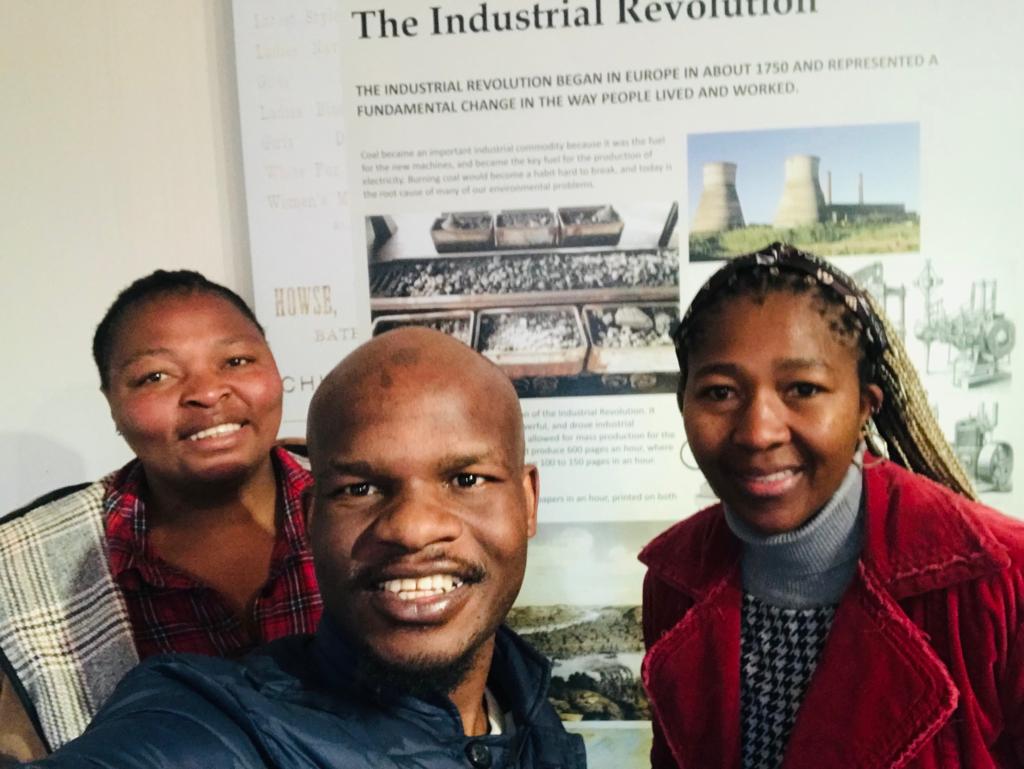
The tour began by exploring the history of printing. It was discussed that, before the invention of printing, books were copied by hand. The Chinese were the first to use movable type, similar to that in the Eastern Star Gallery, in around 1000 CE. Different printing paraphernalia were discussed relating to the movable type. The tour then proceeded to the concept of the Industrial Revolution. The industrial revolution began in Europe in about 1750 and represented an essential shift in the way people lived and worked. The steam machine was central in driving the revolution as it allowed easier transport as well as operating industrial machinery. This was followed by a discussion of the press in South Africa. It was clarified that the press in South Africa has been portrayed by stifling of Freedom of Expression. Key figures in driving for a free press, such as Sol Plaatjie, were highlighted and as well as the different narratives that surrounded the press in South Africa.
The main part of the tour then followed – The Eastern Star. The Eastern Star was a newspaper that was formed in Grahamstown in 1871. The newspaper and its owners later moved from Grahamstown (Makhanda) to Johannesburg following the gold rush to Johannesburg in 1887. The paper was then renamed The Star and is still available on the shelves. The building, its restoration and collections were donated to Amazwi by the then owners of The Star, The Argus Group. The Eastern Star houses exhibits of 19th century printing equipment, including a 120-year old Wharfdale printing press, and an exhibition that examines the history of the press in South Africa.
The concept of Trade Unions was then later discussed. Trade Unions emerged from the Medieval European Guilds and proliferated during the Industrial revolution. Trade unionism in South Africa dates back to the late 19th century. On 27 November 1882, 26 newspapermen met in Grahamstown and formed the Newspaper Press Union with the purpose of promoting and protecting the common interests of the South African press. The NPU was the oldest communication industry association in South Africa until 1996 when it was amalgamated with Print Media South Africa. Finally, the tour dealt with the issue of printing and the environment. It was discussed that the main environmental impacts of printing are the carbon footprint of the process as well as the use of poisonous inks. However, also detrimental to the environment, are the practices of monoculture which damages biodiversity and thus ecosystems at large. Indigenous plants are also cut down to plant trees that can be used to produce paper. The entire process then becomes unsustainable.
The students were then showed various printing machines that are associated with the history of printing that are exhibited within the gallery. A big thank you to the staff that organized the tour!